
HyundaiBook.ru
Repair Chevrolet Repair Honda Repair Toyota Repair Land Rover Repair VAZ Repair Renault Repair Nissan
English Русский
Български
Беларускі
Український
Српски
Hrvatski
Română
Polski
Slovenský
Magyar
ArticlesSitemapContacts  


  Accent   Elantra   Getz   Grandeur   Sonata   Santa Fe   Tucson   Others
Santa Fe 2 (2007-2012, petrol)
  • Main
  • Santa Fe
  • CM (2007-2012)
  • User manual
  • Car driving
  • Electronic Stability Program (ESP)

Electronic Stability Program (ESP) (Hyundai Santa Fe CM)

0
Contents: ESP on/off ⇓ Fault indication ⇓
Electronic stability control system (ESP – Electronic Stability Program) is designed to ensure the stability of the vehicle when turning. The system checks where the driver is turning the steering wheel and where the vehicle is actually moving. To ensure the stability of the vehicle, ESP applies the brakes on individual wheels and adjusts the engine management system. The vehicle's electronic stability program (ESP) helps the driver maintain control of the vehicle in adverse driving conditions. However, it is not a substitute for safe driving instructions.

The effectiveness of ESP in preventing loss of control of the vehicle is affected by factors such as speed, road conditions and steering angle.

Warning! Operating the vehicle with tires or wheels of different sizes may cause ESP to fail. When replacing wheels, make sure that their sizes are the same.


ESP on/off
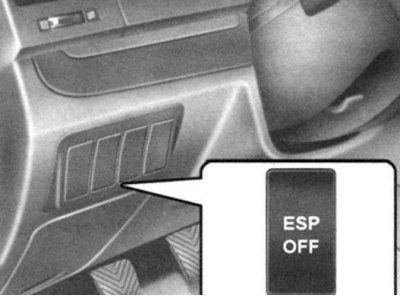


Fig. 1.186. ESP mode activation button

Fig. 1.186. ESP mode activation button


(The article is borrowed from an online resource www.HyundaiBook.ru)

When the vehicle's electronic stability program (ESP) is operating, the ESP indicator on the instrument panel flashes. When ESP is deactivated by pressing the ESP switch, the ESP-OFF indicator lights up. In this case, the vehicle's stability mode is deactivated: you will have to monitor the vehicle's stability yourself. To turn ESP on, press the switch again. ESP will be activated and the ESP-OFF indicator will go out.


Note: The ESP mode is activated automatically after the ignition key is turned to the "ON" position or after the engine is restarted.


Fault indication


After turning the ignition key to the "ON" or "START" position, the indicators on the instrument panel should light up for 3 seconds and then go out. If the indicators do not light up, and the ESP or ESP-OFF indicator does not go out after 3 seconds, contact an authorized Hyundai dealer for vehicle diagnostics.

If unusual conditions occur in the operation of the ESP system while the vehicle is moving, the ESP-OFF indicator lights up as a warning. In this case, stop the vehicle in a safe place and turn off the engine. Then start the engine again and check whether the indicator goes out.
This article is available at russian, bulgarian, belarusian, ukrainian, serbian, croatian, romanian, polish, slovak, hungarian
This article has been reviewed by: Konstantin Smirnov
Add to social network:

Previous
Santa Fe 2: Car driving
Next

Anti-lock braking system
Automatic transmission (4 and 5 speed)
Manual transmission control
Starting the engine
Combination ignition switch
Operation of permanent all-wheel drive (4WD)
4WD all-wheel drive locking system (models with electronically controlled 4WD all-wheel drive)
Correct braking techniques
Economical driving
Towing a trailer or car
We recommend other articles on the topic of Hyundai manuals:

Electronic clock Hyundai Accent 2 (1999-2005)
Immobilizer (electronic anti-theft engine start blocking system) Hyundai Elantra 3 (2000-2006)
Electronic immobilizer (anti-theft engine start blocking system) Hyundai Getz (2002-2011)
General rules when working with an electronic control system Hyundai Sonata 4 (2001-2012, petrol)
Immobilizer (electronic anti-theft engine blocking system)… Hyundai Tucson 1 (2005-2010)
Electronic immobilizer (anti-theft engine start blocking system) Hyundai Matrix (2001-2010, petrol)

Link in different formats to this article

Visitor comments
No comments yet


How much will 19 + 16 ?


Santa Fe 2 (2007-2012, petrol) 
  • User manual
  • Control devices
  • Heating and ventilation
  • Seat control
  • Car driving
  • Maintenance and care
  • Vehicle Specifications
  • Engine 2.0 and 2.4 liters
  • Engine specifications
  • Engine maintenance
  • Engine repair
  • Cooling system
  • Intake and exhaust system
  • Fuel system
  • Engine 2.7 liter
  • Engine maintenance
  • Engine repair
  • Cooling system
  • Intake and exhaust system
  • Transmission
  • Transmission specifications
  • Mechanical gearbox
  • Automatic gearbox
  • Drive shafts
  • Chassis
  • Suspension and wheels
  • Steering
  • Brake system
  • Body
  • Exterior (external elements)
  • Electrical equipment
  • Equipment and devices
  • Power devices
  • Specifications
HyundaiBook.ru © 2018-2026 · Mobile version · Sitemap: EN BG BY UA RS HR RO PL SK HU · Administration · Site search · Hyundai owners Accent 1 · Accent 2 · Accent 3 · Elantra 1 · Elantra 2 · Elantra 3 · Getz · Sonata 3 · Sonata 4 · Santa Fe 2 · Tucson 1 · Tucson 2 · Matrix ·
This site uses cookies to optimize its functionality. By continuing, you agree to our terms.