


Contents: Testing procedures (self-diagnosis) ⇓ Verification operation (using a…⇓ Test operation (using a voltmeter) ⇓
The following situations should be kept in mind:
- 1. The engine starts with difficulty or does not start at all;
- 2. Unstable idle speed;
- 3. The engine does not develop full power.
If any of these faults occur, first perform the self-diagnosis check, then the basic engine check operations (correct engine adjustment, ignition system, etc.), and then check the system components with a scan tool.
Note:
- 1) Before removing or installing any part, read the diagnostic trouble code and then disconnect the negative battery terminal.
- 2) Turn the ignition switch to the "OFF" position before disconnecting the battery cable. Removing or connecting the battery cable while the engine is running with the ignition switch in the "ON" position may cause damage to the Engine Control Module (ECM)
The engine control module monitors input and output signals (some signals continuously, others under specific conditions). In doing so, the ECM detects any malfunction stored in the diagnostic trouble code memory and sends a signal to the self-diagnostic output. The diagnostic results of 15 objects can be read using a voltmeter or a scan tool. Diagnostic trouble codes are stored in the module as long as the battery is operating. If the battery terminal or connector is disconnected, this will erase the trouble codes.
Testing procedures (self-diagnosis)
Note:
- 1) If the battery voltage is low, the diagnostic trouble codes cannot be read. Therefore, check the battery voltage and other conditions before testing.
- 2) The trouble code is cleared if the battery or the ECM connector is disconnected. Therefore, do not disconnect the battery before the diagnostic trouble codes have been completely read.
Verification operation (using a scanning device)
1. Turn the ignition switch to the off position.
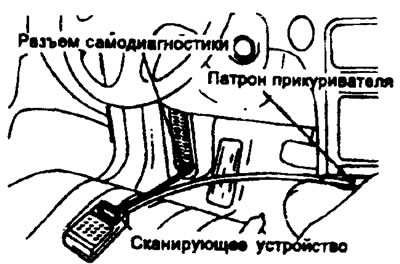
2. Connect the scanning device to the socket in the fuse box.
3. Connect the power supply lead of the scanning device to the cigarette lighter.
4. Turn the ignition switch to the on position.
5. Use the scan tool to check diagnostic trouble codes.
6. Repair the faulty part based on the diagnostic chart.
7. Clear the diagnostic trouble code.
8. Disconnect the scanning device.
Test operation (using a voltmeter)
1. Connect the voltmeter to the data line connector (see figure).
2. Turn on the ignition switch, and the data from the MUD memory will start to be displayed.
After recording the defective object, check and repair it according to the "diagnostic card".
3. After the defective part is repaired, disconnect the negative battery terminal for 15 seconds or more and reconnect it to ensure that the diagnostic trouble code is cleared.