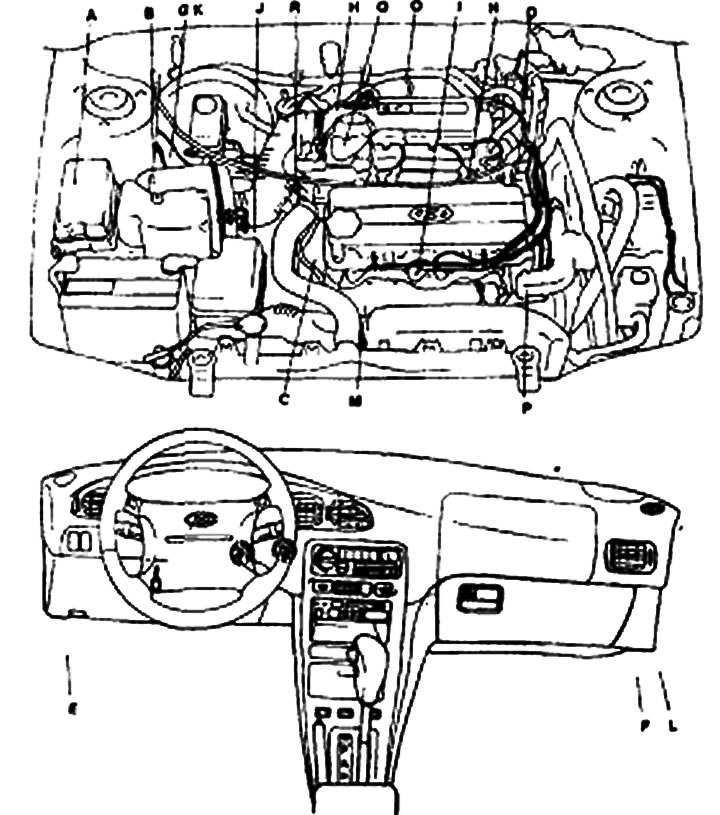
A. Air conditioning system relay.
B. Incoming air flow sensor (includes both incoming air temperature sensor and barometric pressure sensor).
C. Coolant Temperature (ECT) Sensor.
D. Crankshaft position sensor (CSP) and camshaft position sensor.
E. Data acquisition line connector.
F. Engine Control Module (ECM).
G. Fuel pump test output.
H. Idle speed control motor.
I. Nozzles.
J. Transmission selector (TR).
K. Ignition timing adjustment output.
L. Fuel injection control relay.
M. Oxygen sensor.
N. Ignition system transistor.
O. EVAP tank vent solenoid valve.
R. Power steering oil pressure switch.
Q. Throttle Position (TP) Sensor.
R. Vehicle speed sensor.
Removal
1. Release excess pressure in the fuel line to prevent fuel from spilling.
Warning: Cover the fuel line connections with rags to prevent fuel from leaking.
2. Disconnect the injectors and fuel pressure regulator from the distribution line.
Examination
1. Use an ohmmeter to measure the resistance of the electromagnetic injectors between the terminals.
- Resistance - 13-16 Ohm (at 20°C)
2. If the resistance is not within specification, replace the injectors.
Installation
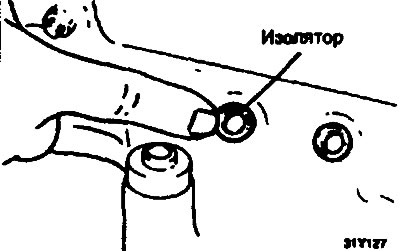
1. Install a new insulator into the intake manifold.
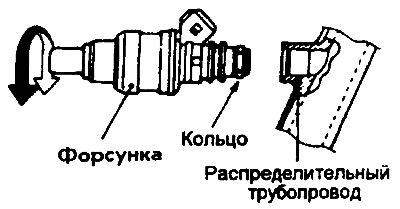
2. Install new bushing and ring on the injectors.
3. Coat the nozzle ring with solvent, spindle oil or gasoline.
4. Turn the nozzle left and right to install it into the distribution pipe.
5. Make sure it turns smoothly without sticking.
Note: If the nozzle does not turn without sticking, the ring may be crushed. In this case, remove the nozzle, reinstall it, and then check again.