


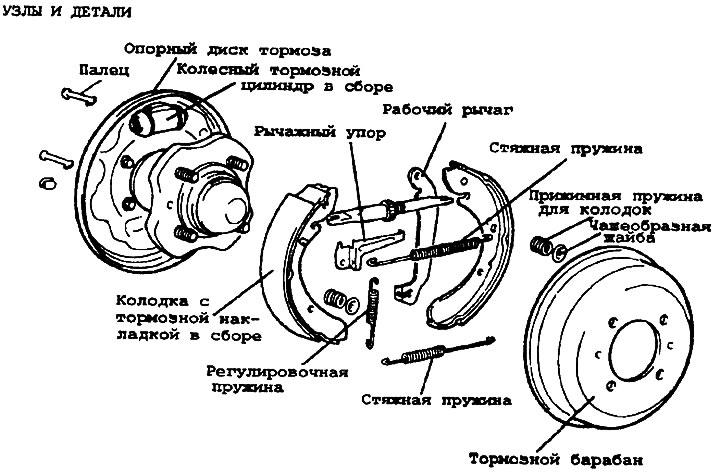
Removal
1. Remove the wheel and tire, and then remove the brake drum.
2. After unscrewing the nut, remove the rear hub together with the brake drum.
3. Remove both tension and pressure springs.
4. Remove the pads and adjuster as a single unit.
Examination
1. Measure the inside diameter of the brake drum. Measure the radial runout of the brake drum using a dial indicator.
| Norm | Limit value | |
| Inner diameter | 228.6 mm | 230.6 mm |
| (2-liter engine) | 225 mm | 227 mm |
| Brake drum ovality | — | 0.015 mm |
2. Measure the thickness of the brake lining on the shoe.
| Norm | Limit value | |
| Brake lining thickness | 4.45 mm | 1.5 mm |
| (2-liter engine) | 5.89 mm | 0.8 mm |
3. Check that the brake linings and brake drum are in proper contact.
4. Check the outside of the brake cylinder for excessive corrosion and defects.
5. Check the brake support disc for wear and damage.
Installation
1. Lubricate the following areas with the recommended lubricant:
- Contact surfaces of the pad and the support disc
- Contact surfaces of the shoe and mounting plate
- Recommended Lubricant - SAE J310, NLGI No.2 General Purpose Lubricant
2. Install the spring pin of the shoe.
3. Assemble the tension spring with the shortened push rod.
Warning: The cotter pin and hub cap must not be reused.
4. After assembling all the brake drum parts, pull the parking brake lever towards you several times.
Replacing the wheel brake cylinder
1. Remove the brake shoe.
2. Disconnect the brake line.
3. Remove the wheel brake cylinder assembly.
4. Remove the dust cover.
5. Remove the piston and piston seal.
6. Remove the tension spring.
7. Before assembling the wheel brake cylinder, check the following parts.
[Material was obtained from an official resource HYUNDAIBOOK.RU]
- 1) Check the cylinder and piston for wear, damage or corrosion.
- Standard clearance between piston and cylinder is 0.039-0.089 mm
- 2) Check the cylinder body for defects and cracks.
- 3) Check the contact surface of the piston and the pad for looseness.
8. Assembly is carried out in the reverse order of disassembly.
Note:
- 1) Clean the cylinder and internal parts with isopropyl alcohol before assembly.
- 2) Apply a sufficient amount of brake fluid to the piston seal and cylinder.
- 3) When assembling, use new piston seals and dust boots.
Warning: Take care not to lose the steel ball in the purge valve.