HyundaiBook.ru
Repair Chevrolet Repair Honda Repair Toyota Repair Land Rover Repair VAZ Repair Renault Repair Nissan
English Русский
Български
Беларускі
Український
Српски
Hrvatski
Română
Polski
Slovenský
Magyar
ArticlesSitemapContacts  


  Accent   Elantra   Getz   Grandeur   Sonata   Santa Fe   Tucson   Others
Getz (2002-2011)
  • Main
  • Getz
  • 1 (2002-2011)
  • Power unit
  • Fuel system
  • Coolant Temperature (ECT) Sensor

Coolant Temperature (ECT) Sensor (Hyundai Getz 1)

0
Contents: Examination ⇓ Installation ⇓
Coolant Temperature (ECT) Sensor


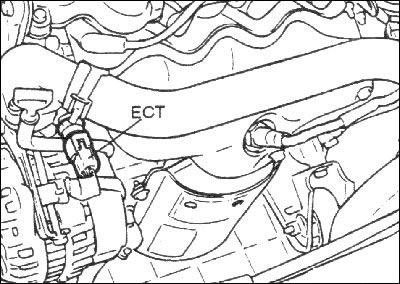
Coolant Temperature (ECT) Sensor

The coolant temperature sensor is installed in the coolant pipe on the cylinder head and monitors the coolant temperature and transmits a signal to the engine control unit ECM. A thermistor is used as a sensor, which is sensitive to temperature changes. The electrical resistance of the thermistor decreases as the temperature increases. The ECM determines the coolant temperature based on the value of the sensor signal voltage and sets the optimal enrichment of the working mixture when the engine warms up.

Examination


Examination


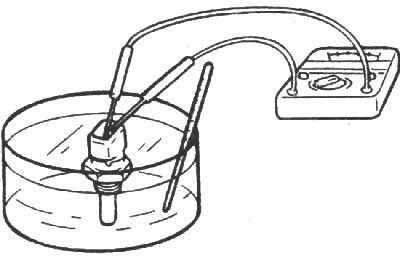
1. Remove the coolant temperature sensor from the intake manifold.


2. By heating a vessel with water and a sensor located in it, check its resistance.

TemperatureResistance
-30°C22.22–31.78 kOhm
-10°C8.16–10.74 kOhm
0°C5.18–6.60 kOhm
20°C2.27–2.73 kOhm
40°C1.059–1.281 kOhm
60°C0.538–0.650 kOhm
80°C0.298–0.322 kOhm
90°C0.219–0.243 kOhm

3. If the sensor resistance differs from the required value, replace the sensor.

Installation


1. Apply LOCTITE 962T or equivalent to the sensor threads.

The article is borrowed from the website: www.hyundaibook.ru

2. Screw in the sensor and tighten it to the torque specified in the specification.

Tightening torque: 15–20 Nm

3. Connect the connector to the sensor.
This article is available at russian, bulgarian, belarusian, ukrainian, serbian, croatian, romanian, polish, slovak, hungarian
This article has been reviewed by: Konstantin Smirnov
Add to social network:

Previous
Getz: Fuel system
Next

Engine Intake Air Temperature (IAT) Sensor
Manifold Absolute Pressure (MAP) Sensor
Malfunction Indicator Lamp (MIL)
MFI fuel injection system
Replacing a two-way valve
Throttle Position (TP) Sensor
Camshaft Position (CMP) Sensor
Crankshaft Position Sensor (CKP)
Heated Oxygen Sensor (HO2S)
Fuel injectors — checking
We recommend other articles on the topic of Hyundai manuals:

Coolant Temperature Sensor and Switch (SOHC Engines) Hyundai Accent 1 (1994-1999)
Coolant Temperature Sensor — Check Hyundai Elantra 1 (1990-1995, petrol)
Coolant Temperature Sensor — Removal, Check, Installation Hyundai Sonata 3 (1993-1998)
Removal and installation the coolant temperature sensor Hyundai Santa Fe 2 (2007-2012, petrol)
Gasoline Engine Coolant Temperature Sensor Hyundai Tucson 2 (2009-2015)
Coolant temperature sensor Hyundai Matrix (2001-2010, petrol)

Link in different formats to this article

Visitor comments
No comments yet


How much will 45 + 34 ?


Getz (2002-2011) 
  • User manual
  • Control devices
  • Heating and ventilation
  • Audio system
  • Car driving
  • Faults en route
  • Maintenance
  • Technical information
  • Power unit
  • Engine repair 1.1/1.3 l
  • Engine repair 1.5/1.6 l
  • Lubrication system
  • Cooling system
  • Fuel system
  • Exhaust system
  • Ignition system
  • Transmission
  • Clutch
  • Mechanical gearbox
  • Automatic gearbox
  • Drive shafts and axles
  • Chassis
  • Suspension and wheels
  • Steering
  • Brake system
  • Body
  • Exterior (external elements)
  • Interior (internal elements)
  • Air conditioning and heater
  • Electrical equipment
  • Equipment and devices
  • Power devices
  • Electrical circuits
HyundaiBook.ru © 2018-2026 · Mobile version · Sitemap: EN BG BY UA RS HR RO PL SK HU · Administration · Site search · Hyundai owners Accent 1 · Accent 2 · Accent 3 · Elantra 1 · Elantra 2 · Elantra 3 · Getz · Sonata 3 · Sonata 4 · Santa Fe 2 · Tucson 1 · Tucson 2 · Matrix ·
This site uses cookies to optimize its functionality. By continuing, you agree to our terms.