


Contents: Keeping the condenser clean ⇓ Checking the efficiency of the air…⇓ Lubrication ⇓ Checking the air conditioning…⇓
Keeping the condenser clean
The air conditioner condenser (and engine cooling system radiator) should be checked periodically for dirt, insects, leaves, etc. When removing deposits, carefully use a brush or a stream of water so as not to bend the fins.
Checking the efficiency of the air conditioner
1. Start the engine and let it run at high idle speed with the air conditioner set to maximum cooling.
2. If the air coming out of the instrument panel vents is not cold, take the vehicle to an authorized Hyundai dealer to have the air conditioning system checked.
Caution: Operating the air conditioner for an extended period of time with a low refrigerant level may damage the compressor.
Lubrication
To lubricate the compressor and seals of the air conditioning system, it is necessary to run the air conditioner for at least 10 minutes each week. This is especially important during cold weather when the air conditioning system is not in use.
Checking the air conditioning compressor drive belt
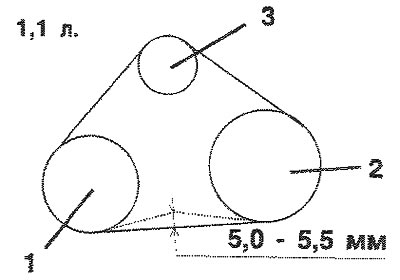
1 - Crankshaft pulley 2 - Air conditioning compressor pulley 3 - Power steering pump pulley |
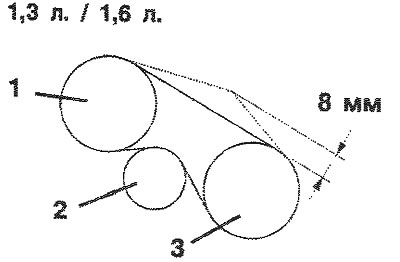
1 - Air conditioning compressor pulley 2 - Tensioner pulley 3 - Crankshaft pulley |
If you use your air conditioner regularly, the tension of the air conditioner compressor drive belt should be checked at least once a month.
To check the tension of the air conditioning compressor drive belt, press on the belt in the middle between the engine crankshaft pulley and the air conditioning compressor pulley.
When you press the belt with your finger, the belt should not deflect more than 8.0 mm (for a 1.1L engine: 5-5.5 mm). If you have tools to check the belt tension with a force of 98 N, its deflection should be approximately 8.0 mm. If the belt tension is too weak, take the vehicle to an authorized Hyundai dealer for adjustment.