
HyundaiBook.ru
Repair Chevrolet Repair Honda Repair Toyota Repair Land Rover Repair VAZ Repair Renault Repair Nissan
English Русский
Български
Беларускі
Український
Српски
Hrvatski
Română
Polski
Slovenský
Magyar
ArticlesSitemapContacts  


  Accent   Elantra   Getz   Grandeur   Sonata   Santa Fe   Tucson   Others
Getz (2002-2011)
  • Main
  • Getz
  • 1 (2002-2011)
  • Electrical equipment
  • Power devices
  • Checking the current generated by the generator

Checking the current generated by the generator (Hyundai Getz 1)

0
Contents: Preparing for the test ⇓ Examination ⇓ Check result ⇓
This test determines whether the generator produces a current that is equivalent to its rated power.

Preparing for the test


1. Before testing, check the following items:
  • a) the condition of the battery installed in the vehicle;

Note: The battery used to test the current generated by the alternator must be partially discharged. If the battery is fully charged, the test cannot be performed due to insufficient load on the alternator.

  • b) tension of the generator drive belt.

2. Turn off the ignition.

3. Disconnect the cable from the negative terminal of the battery.

4. Disconnect the wire from the generator terminal "B".

5. Connect a 0-100A DC ammeter in series between terminal "B" and the wire disconnected from the generator. Make sure that the negative probe of the ammeter is connected to the wire disconnected from the generator.

Note: Connect the wires and ammeter probes very securely as a large current will flow through the circuit.


6. Connect a voltmeter (0-20 V) to the generator terminal "B" and to ground.

Make sure the positive probe of the voltmeter is connected to the "B" terminal of the generator.

7. Connect the tachometer and the wire to the negative terminal of the battery.

8. Leave the hood open.
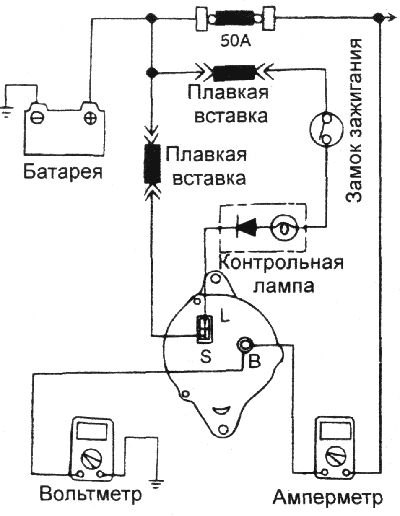
8. Leave the hood open.


Examination


1. Check that the voltmeter scale is clearly visible to determine the voltage value. If the voltmeter shows a voltage of 0 V, then the electrical circuit connecting the generator terminal "B" and the negative terminal of the storage battery is not closed, the fuse link is burnt out, or the connection to the "ground" is unreliable.

2. Start the engine and turn on the headlights.

3. Turn on the high beam headlights and the heater fan to maximum air supply. Briefly increase the engine speed to 2,500 min⁻¹ and read the values on the instruments, while the ammeter will show the maximum current produced by the generator.

Note: After starting the Hyundai Getz engine, the battery charging current decreases very quickly, so this check must be performed very quickly.


Check result


1. The ammeter reading should be greater than the limit value. If the current value is less than the limit value and the wire connecting the generator output is normal, remove the generator from the car and check it.

Current Limit:
  • generator 70A: not less than 49.0 A
  • generator 90A: not less than 63.0 A

Note.
  • 1. The nominal current value is indicated on the plate attached to the generator body.
  • 2. The current generated by the generator depends on the temperature and load. Therefore, to obtain the maximum current value, partially discharge the battery, first turning on the headlights of the car with the engine off.


The maximum value of current produced by the generator cannot be obtained if the generator or ambient air temperature is too high.


Original version of the article on the website: www.hyundaibook.ru

2. After completing the generator current limit test, idle the engine and turn off the ignition.

3. Disconnect the cable from the negative terminal of the battery.

4. Remove the tachometer, voltmeter and ammeter.

5. Connect the wire to the "B" terminal of the generator.

6. Connect the cable to the negative terminal of the battery.
This article is available at russian, bulgarian, belarusian, ukrainian, serbian, croatian, romanian, polish, slovak, hungarian
This article has been reviewed by: Konstantin Smirnov
Add to social network:

Previous
Getz: Power devices
Next

Checking the voltage drop on the wire connecting the battery to the generator
Description of the charging system operation
Troubleshooting the Engine Starting System
Troubleshooting the charging system
Checking the regulated voltage
Generator — removal, disassembly and installation
Battery — Checking, Charging and Precautions
Engine starting system
Ignition system — removal, installation and testing
We recommend other articles on the topic of Hyundai manuals:

Checking the current generated by the generator Hyundai Accent 2 (1999-2005)
Checking the current generated by the generator Hyundai Elantra 3 (2000-2006)
Checking the engine oil level Hyundai Sonata 3 (1993-1998)
Checking the generator output current (2.4 l) Hyundai Santa Fe 2 (2007-2012, petrol)
Checking and adjusting valve clearances Hyundai Tucson 1 (2005-2010)
Checking the generator output current Hyundai Matrix (2001-2010, petrol)

Link in different formats to this article

Visitor comments
No comments yet


How much will 41 + 48 ?


Getz (2002-2011) 
  • User manual
  • Control devices
  • Heating and ventilation
  • Audio system
  • Car driving
  • Faults en route
  • Maintenance
  • Technical information
  • Power unit
  • Engine repair 1.1/1.3 l
  • Engine repair 1.5/1.6 l
  • Lubrication system
  • Cooling system
  • Fuel system
  • Exhaust system
  • Ignition system
  • Transmission
  • Clutch
  • Mechanical gearbox
  • Automatic gearbox
  • Drive shafts and axles
  • Chassis
  • Suspension and wheels
  • Steering
  • Brake system
  • Body
  • Exterior (external elements)
  • Interior (internal elements)
  • Air conditioning and heater
  • Electrical equipment
  • Equipment and devices
  • Power devices
  • Electrical circuits
HyundaiBook.ru © 2018-2026 · Mobile version · Sitemap: EN BG BY UA RS HR RO PL SK HU · Administration · Site search · Hyundai owners Accent 1 · Accent 2 · Accent 3 · Elantra 1 · Elantra 2 · Elantra 3 · Getz · Sonata 3 · Sonata 4 · Santa Fe 2 · Tucson 1 · Tucson 2 · Matrix ·
This site uses cookies to optimize its functionality. By continuing, you agree to our terms.