


Contents: Checking the oil level (ATF) in the…⇓ Automatic transmission oil change…⇓ Replacing the automatic transmission…⇓
Checking the oil level (ATF) in the automatic transmission
Drive the vehicle until the transmission fluid (ATF) reaches normal operating temperature (70–80°C).
Place the vehicle on a level, horizontal surface.
Press the brake pedal and move the automatic transmission selector lever sequentially through all positions (holding it in each of them for a few seconds) to fill the entire automatic transmission control hydraulic system and the automatic transmission torque converter with oil (ATF), and then set the selector lever to the "N" position.
Before removing the dipstick, clean the area around it from dirt. Remove the dipstick and check the condition of the transmission oil (ATF).
Note. If the oil (ATF) in the automatic transmission has a burnt smell, this is a sign of contamination with small particles of wear of the friction linings of the transmission control elements. In this case, a major overhaul of the gearbox may be required.
The normal ATF level should be in the "HOT" range on the dipstick. If the level is below this, add ATF to the normal level.
Automatic transmission fluid (ATF): GENUINE HYUNDAI ATF SP-II M.
Note: If the ATF level is below normal, the oil pump will suck in oil along with air, causing bubbles and foaming of the oil in the hydraulic system. This will reduce the operating pressure in the hydraulic control system, which in turn will cause a delay in gear shifting (late gear engagement) and slippage of the friction clutches or brakes. If the ATF level is higher than normal, the rotation of the planetary gears will cause abundant foaming of the ATF, which will ultimately lead to the same consequences as in the case of a low ATF level. In both cases, air bubbles cause overheating, oxidation of the ATF and varnish deposits, which will damage valves, clutches and actuators. Foaming also causes ATF to be ejected through the ATF crankcase breather, which is mistaken for leaks.
Insert the dipstick firmly into the standard hole.
In case of major repairs of the automatic transmission or operation of the car in difficult road conditions, replacement of oil in the automatic transmission (ATF) and oil filter is mandatory. The procedure for replacing oil in the automatic transmission (ATF) is described below. It is necessary to remember that only special oil filters are used in automatic transmissions.
Attention! It is important to remember that only special oil filters are used in automatic transmissions.
Automatic transmission oil change (ATF)
You can use the installation for quick oil change (ATF) in automatic transmission (ATF fluid charger). If there is no such installation, replace the oil (ATF) in the automatic transmission as described below.
Draining oil (ATF) from the automatic transmission hydraulic system:
- disconnect the hose that connects the gearbox to the oil cooler located inside the engine cooling radiator;
- start the engine and allow the oil (ATF) to drain through the hose.
Conditions for performing the operation:
- the engine is idling;
- the automatic transmission selector lever is in the "N" position.
Attention! The engine must be turned off one minute after starting. If all the oil (ATF) has leaked out before this moment, the engine must be turned off immediately.
Unscrew the drain plug on the bottom of the automatic transmission housing and drain the oil (ATF) from the automatic transmission oil pan.
Install the drain plug with the gasket in place and tighten the plug to a torque of 32 N·m.
Fill in new automatic transmission fluid (ATF) through the automatic transmission oil filler tube.
Caution! If the nominal volume of automatic transmission fluid (ATF) does not fit into the gearbox, stop filling.
Note: Check for contamination in the drained oil (ATF). If the automatic transmission has more oil (ATF) than the nominal volume, let the oil drain from the gearbox again.
Replace the external automatic transmission oil filter. If the oil (ATF) is significantly contaminated, check the condition of the internal automatic transmission oil filter.
Fill in new automatic transmission fluid (ATF) through the automatic transmission oil filler tube.
Connect the automatic transmission oil cooler hose and securely install the dipstick in place. Before installing the automatic transmission oil dipstick, clean the area around it from dirt.
Start the engine and let it idle for 1–2 minutes.
Move the automatic transmission selector lever sequentially through all positions and then set it to the "N" position.
Make sure the ATF level is within the COLD range of the dipstick. If the level is below this, add the required amount of ATF.
Drive the car for some distance so that the oil temperature (ATF) reaches the normal operating value (70–80°C), then check the automatic transmission oil level (ATF) again, which should be in the "HOT" range ("warmed up automatic transmission").
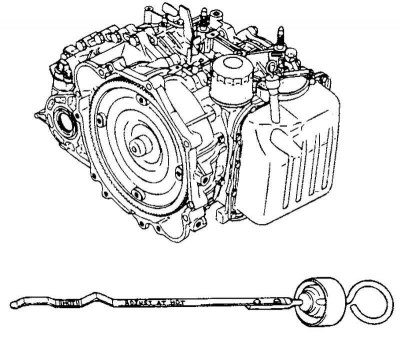
Fig. 3.60. Oil dipstick
Install the oil dipstick tightly into the automatic transmission oil filler tube (Fig. 3.60).
Replacing the automatic transmission oil filter
Remove the air filter assembly, then use a special tool (oil filter chain wrench, etc.) to remove the automatic transmission oil filter.
After removing the filter, use cloth gloves or a rag to clean the gearbox surface from splashes of automatic transmission fluid (ATF), dirt, etc.
Clean the mounting surface of the automatic transmission oil filter.
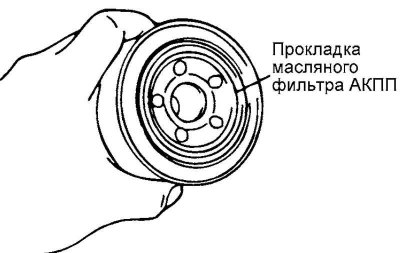
Fig. 3.61. Oil filter gasket
Lubricate the surface of the automatic transmission oil filter O-ring with a small amount of clean automatic transmission oil (ATF) (Fig. 3.61).
Install the automatic transmission oil filter back into place.
Tightening torque: 11–13 Nm.
Check the automatic transmission fluid (ATF) level in the gearbox.