


Before performing a test, always check the following:
- installation of the generator and connection of wires;
- alternator drive belt tension;
- fusible link;
- absence of extraneous noise from the generator when the engine is running.
Turn the ignition key to the "OFF" position.
Disconnect the wire from the (–) terminal of the battery.
Disconnect the standard wire from the generator terminal "B". Connect an ammeter (DC, with a range of 0-100 A) in series between the generator terminal "B" and its standard wire. (Connect the (+) wire of the ammeter to the generator terminal "B", and then the (-) wire of the ammeter to the wire disconnected from the generator).
Note: We recommend using an ammeter with an inductive type sensor (current clamp), which allows you to measure current without disconnecting the wire from the generator terminal "B". Using this device eliminates the possibility of voltage drop due to poor connection to the generator terminal "B".
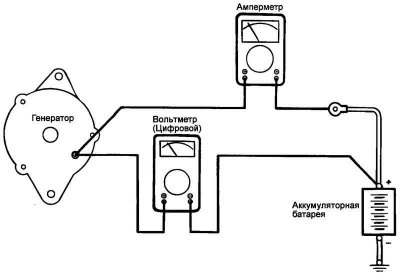
Fig. 7.22. Generator output voltage drop test circuit
Connect a digital voltmeter between the alternator B terminal and the (+) battery terminal. Connect the (+) lead of the voltmeter to the alternator B terminal, and then the (–) lead of the voltmeter to the (+) battery terminal (Fig. 7.22).
Connect the previously disconnected wire to the (–) terminal of the battery.
Connect a test tachometer or tester.
Start the engine.
Maintaining the engine speed at approximately 2500 min⁻¹, turn the headlights and exterior lights on and off, thereby adjusting the load on the generator so that the output current (shown on the ammeter) is slightly higher than 30 A.
Maximum allowable value: 0.3V maximum.
Note: If the generator output is high and you cannot reduce the ammeter reading to 30 A by turning on the load, then set the generator output current to 40 A. The maximum permissible voltage drop for an output current of 40 A is 0.4 V.
If the voltmeter reading exceeds the maximum permissible value, then there is probably a malfunction in the output circuit of the generator terminal "B". In this case, you should check the circuits between the generator terminal "B" and the (+) terminal of the storage battery (including the fuse link). If the wire attachment to the generator terminal has become loose, or if the insulation of the wires in the harness has changed color due to overheating, then fix the malfunction and recheck.
After completing the check, let the engine idle.
Turn off all exterior lights, then turn the ignition switch to the "OFF" position.
Disconnect the test tachometer or tester.
Disconnect the wire from the (–) terminal of the battery.
(The original text is published on the website HyundaiBook)
Disconnect the voltmeter and ammeter.
Connect the standard wire to the "B" terminal of the generator.
Connect the wire to the (–) terminal of the battery.