
HyundaiBook.ru
Repair Chevrolet Repair Honda Repair Toyota Repair Land Rover Repair VAZ Repair Renault Repair Nissan
English Русский
Български
Беларускі
Український
Српски
Hrvatski
Română
Polski
Slovenský
Magyar
ArticlesSitemapContacts  


  Accent   Elantra   Getz   Grandeur   Sonata   Santa Fe   Tucson   Others
Matrix (2001-2010, petrol)
  • Main
  • Hyundai
  • Matrix (2001-2010)
  • Chassis
  • Suspension and wheels
  • Removal, checking and installation the lower arm of the front suspension

Removal, checking and installation the lower arm of the front suspension (Mitsubishi Matrix)

0
Contents: Removal ⇓ Installation ⇓ Replacing the protective cover and…⇓ Replacing the lower control arm "G"…⇓ Examination ⇓
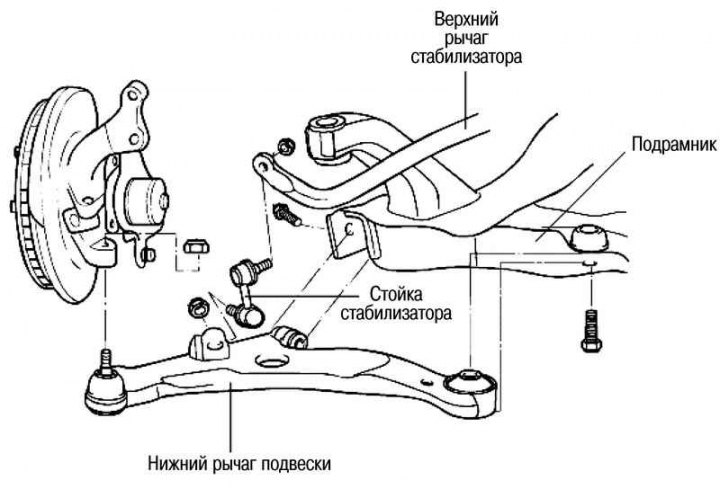
Fig. 4.25. Lower suspension arm

Fig. 4.25. Lower suspension arm


Removal


Remove the front wheel.

Remove the cotter pin, unscrew the wheel drive shaft mounting nut and remove the washer.

Loosen the nut securing the lower suspension arm ball joint to the steering knuckle; do not unscrew the nut completely.

Unscrew the two bolts securing the front strut to the steering knuckle (lower).

Pull the wheel hub outward from the vehicle and separate the wheel drive shaft from it.
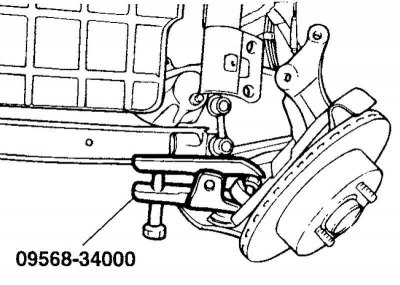
Fig. 4.26. Disconnecting the lower arm…

Fig. 4.26. Disconnecting the lower arm ball joint


Using a special tool (09568-34000) disconnect the lower arm ball joint from the lower arm (Fig. 4.26).


Temporarily install the front strut to steering knuckle mounting bolts (lower).

Loosen the stabilizer bar mounting nut.

Unscrew the two bolts securing the bushings "A" and "G" of the lower arm.

Remove the lower control arm assembly.

Installation
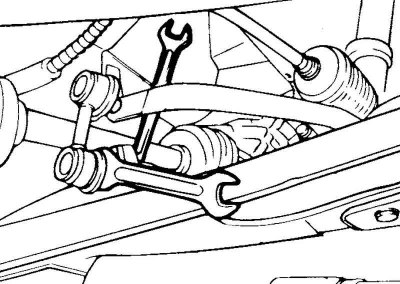


Fig. 4.27. Tightening the self-locking…

Fig. 4.27. Tightening the self-locking nut


When tightening the stabilizer strut mount, hold the ball joint from turning with a wrench (14 mm), tighten the self-locking nut (Fig. 4.27).

Replacing the protective cover and ball joint of the lower arm
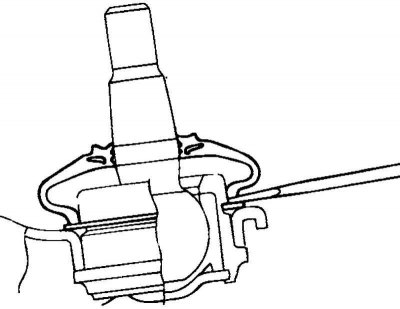


Fig. 4.28. Removing the protective…

Fig. 4.28. Removing the protective cover from the ball joint of the lower arm


Using a flat-head screwdriver, remove the protective cover from the lower arm ball joint (Fig. 4.28).

Remove the retaining ring.
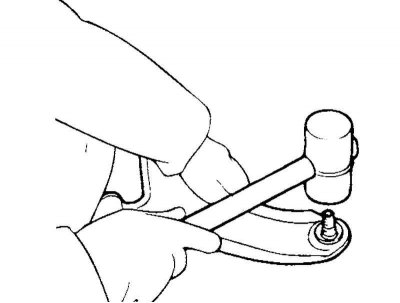
Fig. 4.29. Removing the ball joint from…

Fig. 4.29. Removing the ball joint from the lower arm


Using a plastic hammer, knock the ball joint out of the lower arm (Fig. 4.29).
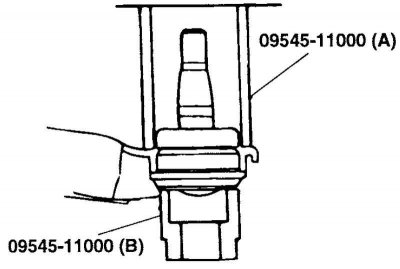
Fig. 4.30. Pressing a new ball joint…

Fig. 4.30. Pressing a new ball joint into the lower arm


Using a special tool (09545-11000) press the new ball joint into the lower arm assembly (Fig. 4.30).

Install the retaining ring.
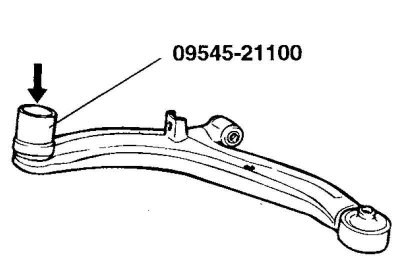
Fig. 4.31. Installing the protective…

Fig. 4.31. Installing the protective cover


Using a special tool (09545-21000) install the protective cover (Fig. 4.31).

Replacing the lower control arm "G" bushing
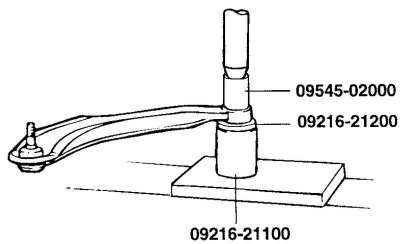


Fig. 4.32. Installing special tools on…

Fig. 4.32. Installing special tools on the lower arm


Install the special tools (09545-02000, 09216-21200 and 09216-21100) on the lower arm (Fig. 4.32).

Press out the bushing.

Wet the following parts with soapy water:
  • the outer surface of the bushing;
  • the inner mounting surface of the lower arm under the bushing.
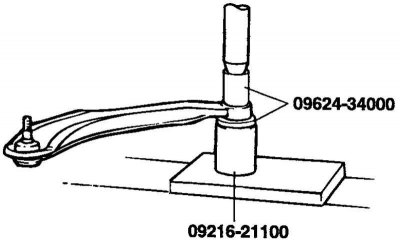
Fig. 4.33. Installing a new bushing on…

Fig. 4.33. Installing a new bushing on the lower arm


Install a new bushing on the lower arm using the special tool (09216-21100 and 09624-34000) (Fig. 4.33).
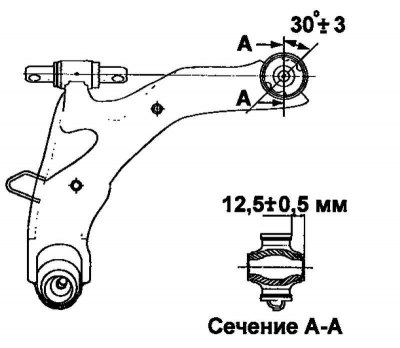
Fig. 4.34. Pressing in the «G» bushing…

Fig. 4.34. Pressing in the "G" bushing of the lower arm


Note: Press in the lower arm bushing "G" at an angle as shown in Figure 4.34.


Examination


Check the rubber bushings for wear or deformation.

Check the lower control arm for bending or cracks.

Check the ball joint protective cover for cracks and damage.


Check all bolts for deformation and damage.
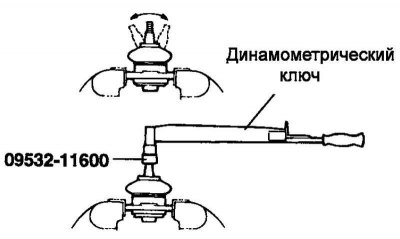
Fig. 4.35. Checking the torque

Fig. 4.35. Checking the torque


Check the rotation torque of the lower arm ball joint pin (Fig. 4.35).

If there are cracks or tears in the ball joint protective boot, replace the lower arm ball joint assembly.

Rock the lower arm ball joint pin several times.

Measure the torque of the lower arm ball joint pin.

Nominal value: 3.5–4 Nm.

If the torque exceeds the upper limit of the nominal value, replace the lower arm ball joint assembly.

If the torque is less than the lower limit of the nominal value, then re-installation of this ball joint is allowed, if there is no jamming or excessive play of the hinge pin.
This article is available at russian, bulgarian, belarusian, ukrainian, serbian, croatian, romanian, polish, slovak, hungarian
This article has been reviewed by: Konstantin Smirnov
Add to social network:

Previous
Matrix: Suspension and wheels
Next

Disassembly, inspection and assembly of the front shock absorber strut
Removal and installation the front shock absorber strut
Wheels and tires — alignment and rotation
Removal, checking and installation the front anti-roll bar
Removal, disassembly, inspection and installation of the rear shock absorber strut
Removal and checking the rear suspension trailing arm
Table 4.1. Suspension specifications
Table 4.2. Basic data for adjustments and control
We recommend other articles on the topic of Hyundai manuals:

Lower control arm of the front suspension Hyundai Accent 1 (1994-1999)
Checking the elements of the front suspension of the car Hyundai Elantra 1 (1990-1995, petrol)
Lower control arm front suspension — removal and installation Hyundai Getz (2002-2011)
Lower control arm of the front suspension Hyundai Sonata 4 (2001-2012, petrol)
Removal, checking and installation the front wheel drive shaft Hyundai Santa Fe 2 (2007-2012, petrol)
Lower control arm of the front suspension Hyundai Tucson 2 (2009-2015)

Link in different formats to this article

Visitor comments
No comments yet


How much will 13 + 20 ?


Matrix (2001-2010, petrol) 
  • User manual
  • Control devices
  • Salon equipment
  • Car driving
  • Current service
  • Vehicle specifications
  • Power unit
  • Engine specifications
  • Engine maintenance
  • Engine repair 1.6 l
  • Engine repair 1.8 l
  • Cooling and lubrication system
  • Power and exhaust system
  • Control system
  • Transmission
  • Transmission specifications
  • Clutch
  • Mechanical gearbox
  • Automatic gearbox
  • Drive shafts
  • Chassis
  • Suspension and wheels
  • Steering
  • Brake system
  • Body
  • Exterior (external elements)
  • Passive safety system
  • Heater and air conditioner
  • Electrical equipment
  • Specifications
  • Equipment and devices
  • Power devices
  • Electrical circuits
HyundaiBook.ru © 2018-2026 · Mobile version · Sitemap: EN BG BY UA RS HR RO PL SK HU · Administration · Site search · Hyundai owners Accent 1 · Accent 2 · Accent 3 · Elantra 1 · Elantra 2 · Elantra 3 · Getz · Sonata 3 · Sonata 4 · Santa Fe 2 · Tucson 1 · Tucson 2 · Matrix ·
This site uses cookies to optimize its functionality. By continuing, you agree to our terms.