


Checking spark plugs
(when the engine crankshaft can be turned by the starter)
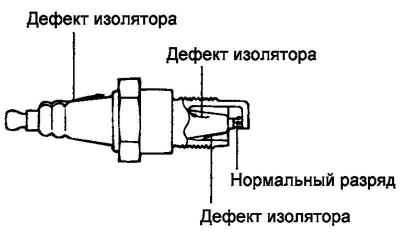
Fig. 7.6. Insulator defect
Connect the high-voltage spark plug wire to the spark plug removed from the cylinder head. Connect the outer electrode (housing) of the spark plug to the ground (to the bracket on the engine), crank the engine crankshaft with the starter. If the spark plug is in good condition, a spark will jump between the spark plug electrodes (rather weak, since the discharge occurs in the atmosphere with a small gap). If the spark plug is faulty, no spark will appear due to charge leakage along the spark plug insulator (Fig. 7.6).
Checking the high voltage spark plug wires
Check the cap and wire insulation for cracks.
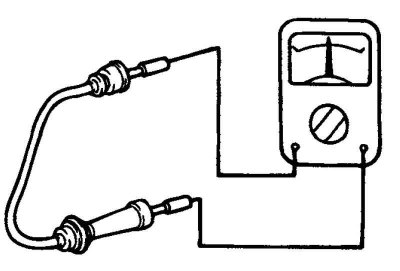
Fig. 7.7. Spark plug wire resistance measurement diagram
Measure the resistance of the wire (Fig. 7.7).
Note: The resistance of the spark plug wire must not be higher than 10 kOhm (BOUGI) or 22 kOhm (R16AIPS) per meter of wire length. If the wire resistance is higher than the specified value, replace the wire.