


Contents: How to use electrical equipment…⇓ Designations of connectors,…⇓ Connector markings ⇓ Wire marking ⇓ Color coding ⇓ Table of designations of electrical…⇓ Abbreviations ⇓
How to use electrical equipment diagrams
Each diagram represents a separate subsystem of electrical equipment from the fuse (or fuse link) to the "ground". To simplify the understanding of the diagram, the power source is shown at the top of the diagram, and the "ground" is at the bottom.
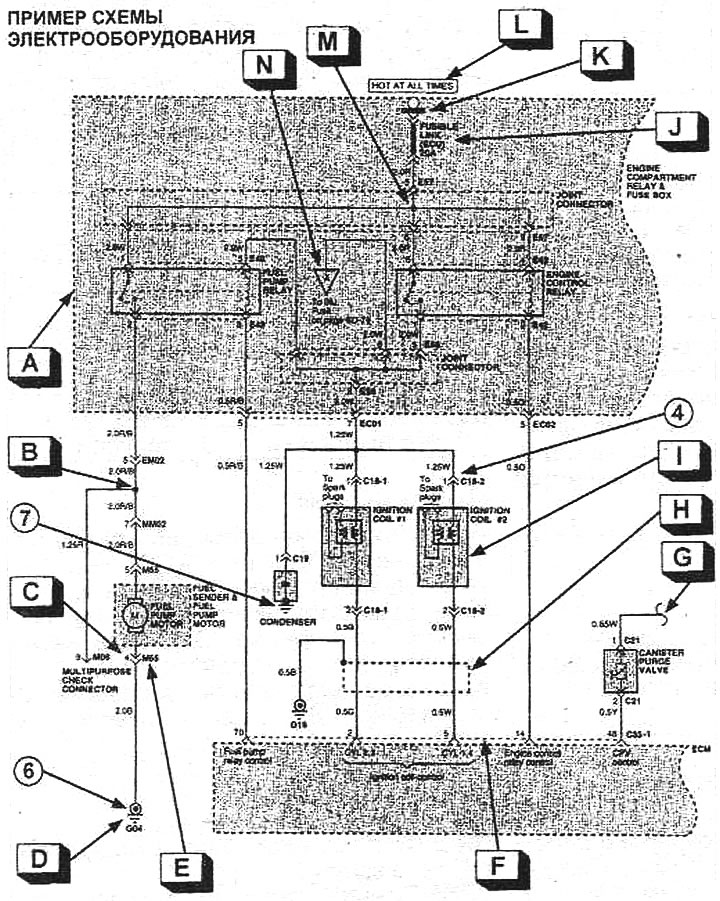
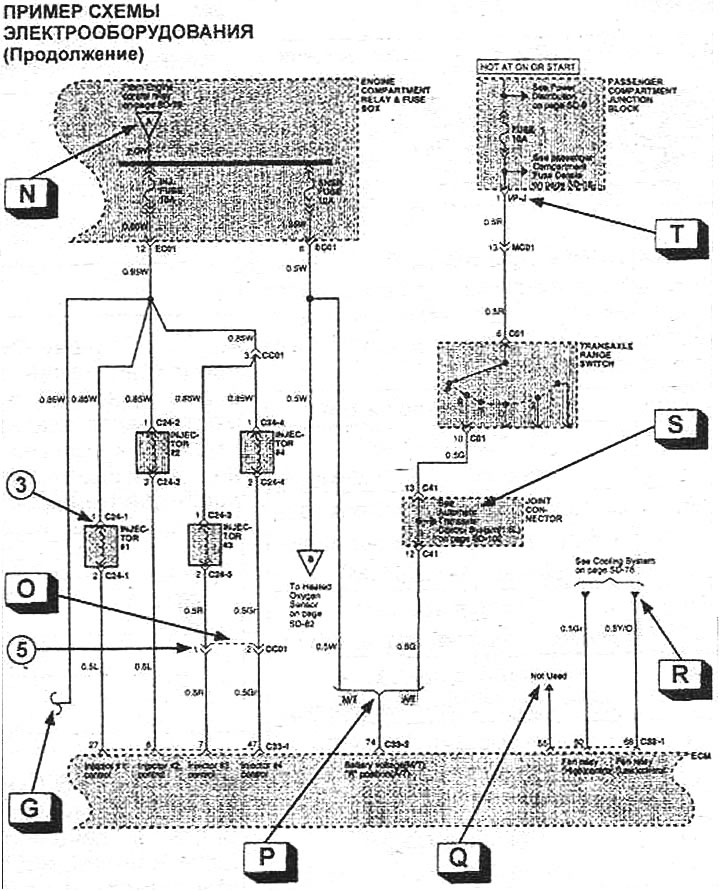
- A: In this case, the dashed line indicates that the circuit diagram shows only part of the component.
- B: Indicates a branching point in the wiring where the wire diameter or color may change.
- C: Indicates the pin number in the connector.
- D: Indicates the ground point. (The ground point number corresponds to the number shown on the wire harness layout diagram and component layout diagrams.)
- E: Indicates the connector number only. It corresponds to the connector number shown on the wiring harness diagram. The connector image is on a separate page.
- F: When two or more connectors are connected to one device, the terminals of one connected connector are marked with a broken line (—).
- G: Indicates that the circuit continues on to the next part of the circuit diagram.
- H: Indicates a shielded wire harness connected to ground.
- I: In this case, the solid line indicates that the component is shown in its entirety on the circuit diagram.
Note: The operating conditions, characteristics, etc. may be given next to a component (for example, a sensor switch).
- J: Indicates the name of the fuse or fusible link and its rating.
- K: Indicates that there is a jumper connecting this circuit to other fuses or fusible links.
- L: Indicates the conditions (ignition switch position) when power is supplied to this target.
- M: Indicates the point where multiple wires are connected within a connector.
- N: Indicates that the chain continues at point Уб7 elsewhere on the diagram.
- A: The broken line (—) indicates that the terminals belong to the same intermediate connector.
- R: Indicates different configuration options for which differences are shown in the electrical diagram.
- Q: Indicates that the pin is a spare.
- R: Indicates that at this point on the electrical diagram only a part of the circuit is shown and the complete circuit can be viewed at the provided link.
- S: Name of the target system that has a connection with the system in question.
- T: Symbols such as "I/P-" in the connector number indicate that the connector is connected to a central branching point (relay box, fuse box, etc.).
Designations of connectors, connections and components
1: Connector designation on the electrical diagram.
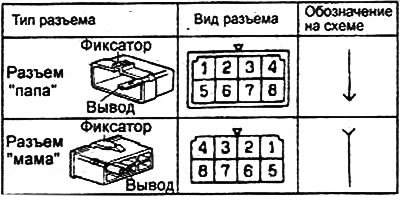
2: Connector pin numbering. The connector pin numbering is always indicated in the order shown by the arrow in the figure.
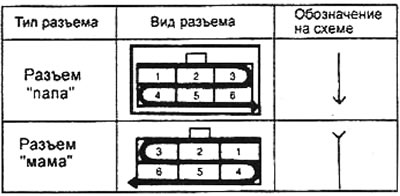
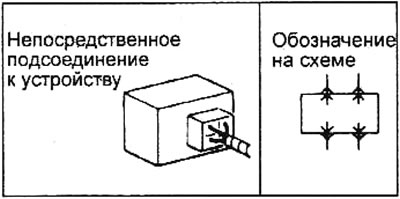
3: Indicates that the harness connector connects directly to the device.
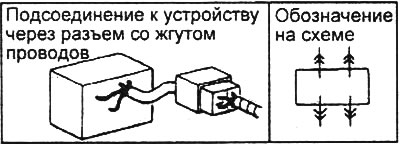
4: Indicates that the harness connector is connected to the device connector that includes the wiring.
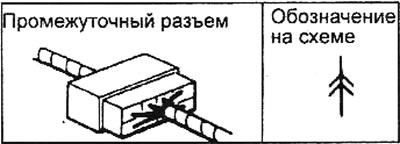
5: Indicates an intermediate connector.
6: Indicates the connection to the body ground (metal body part).
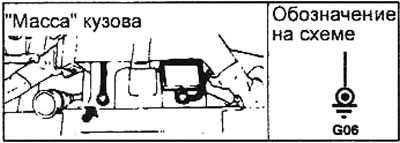
7: Indicates the connection to the device ground (to the device body, which contacts the body).
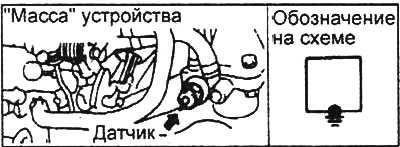
Connector markings
1. Connectors are divided into groups according to their location on the vehicle and have a symbolic designation (the first symbol in the designation).
| Group | Location |
| E | Engine bay (engine wiring) |
| M | Interior, floor and roof (wiring of interior and exterior components) |
| WITH | Engine compartment (wiring of control systems) |
| R | Rear of the body (wiring of the runner cover) |
| I | Floor and dashboard (SRS system wiring and instrument panel components) |
| D | Side doors (wiring inside the door) |
| G | Connection points with the "mass" |
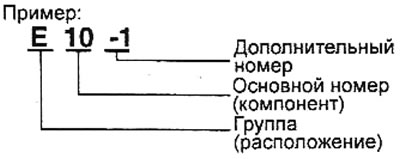
2. The designation of a standard component connector includes a symbol indicating group membership (by location), the main component number (changes sequentially), and an additional connector number (if the component has several connectors).
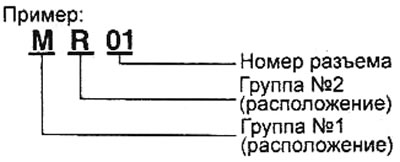
3. The designation of the intermediate connector, which connects the wire harnesses of different groups, includes symbols of group membership (by location) for both wire harnesses and the connector number (changes sequentially).
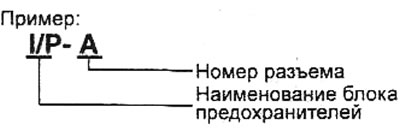
4. The fuse box connector designation contains symbols that clearly characterize the location of the unit in the vehicle (for example, I/P - unit in the passenger compartment) and the connector symbol (changes sequentially).
Wire marking
Wires differ in the color of the insulation and the cross-section of the conductive part depending on what electrical devices they are connected to.
The diagrams indicate the wire marking with a letter code (see figure):
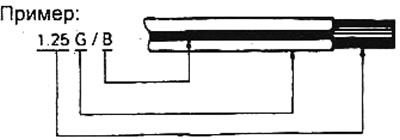
1.25: Wire cross-section size in mm².
G: Main color of the wire.
B: Additional wire color (strip color) if the wire is two-color.
Color coding
Colors of wire insulation, colors of fuse links and fuses.
Note: When the wire insulation color code is two-letter (e.g. R/G), the first letter indicates the main color of the wire (red) and the second letter indicates the color of the stripe on the wire (green).
| Code | Color | Code | Color |
| IN | black | ABOUT | orange |
| BR | brown | R | pink |
| G | green | R | red |
| Gr | grey | W | white |
| L | blue | Y | yellow |
| LG | light green | Rr | violet |
| T | yellow-brown. | LI | blue |
Table of designations of electrical equipment components
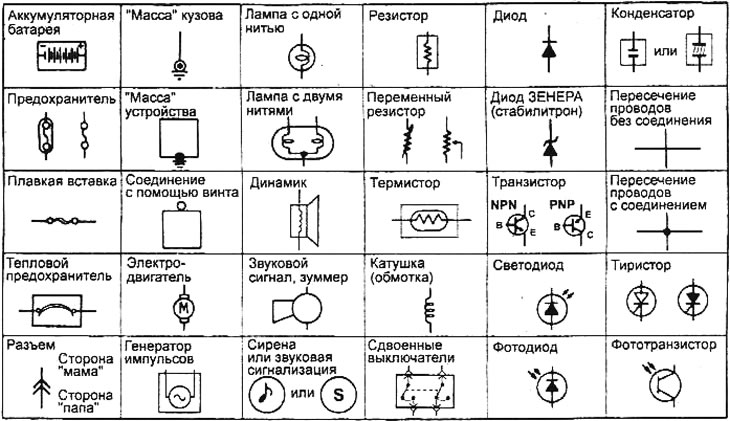
Abbreviations
- ACC: When the ignition key is turned to the "ON" or "ACC" position, the power supply circuit starts to function.
- IG1: Even when the ignition key is turned to the "ST" position, the power supply circuit starts to function.
- IG2: When the ignition switch is turned to the "ST" position, the power supply circuit does not function.
- GND: "Mass".
- ILL: Backlight lamp.
- IND: Indicator (indication).
- DRL: Daytime Running Light System.
- EPS: Electric Power Steering.